Canmore Real Estate Market Q1 2026: A Shift Toward Balance as Inventory Builds
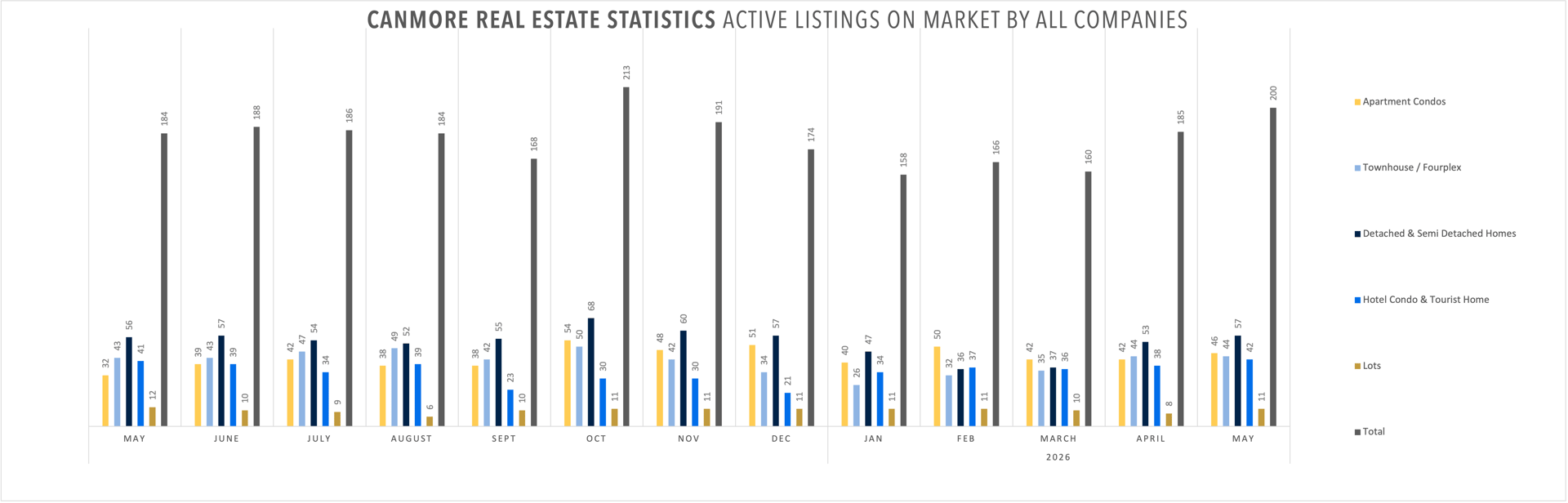
The Canmore and Bow Valley real estate market entered 2026 with a notable shift in tone. After several years defined by constrained supply and accelerated price growth, Q1 2026 reflects a market moving toward balance, as inventory levels rise across nearly every segment.
This is not a reversal of the market’s long-term trajectory. Rather, it is a normalization—one that introduces greater choice for buyers, more competition for sellers, and a more nuanced landscape across property types.
A Higher Starting Point: Inventory Trends Define the Quarter
The most important story in Q1 is inventory.
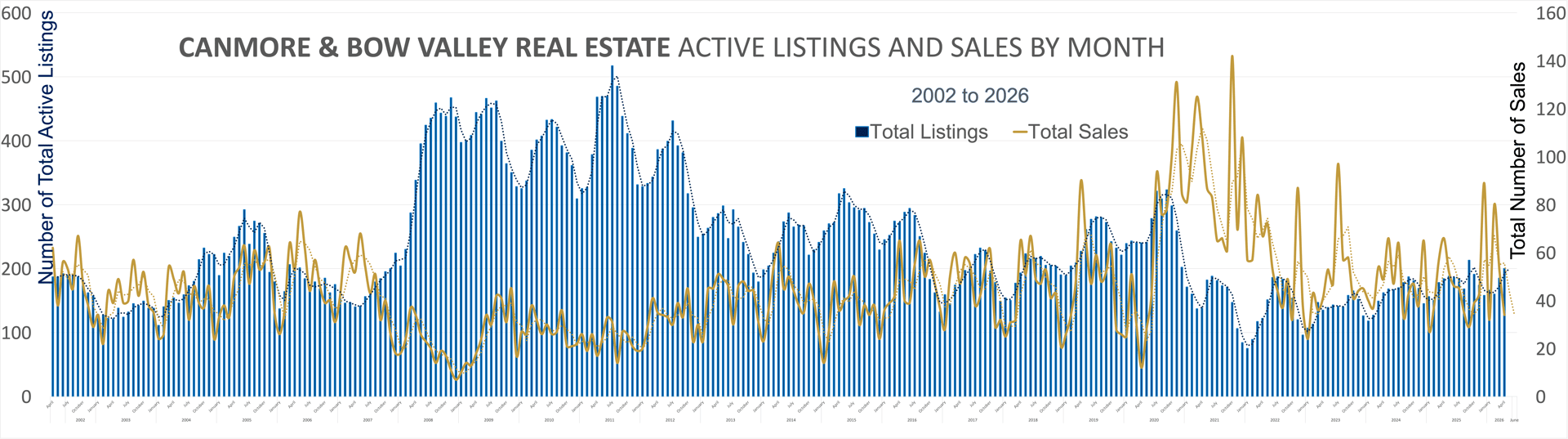
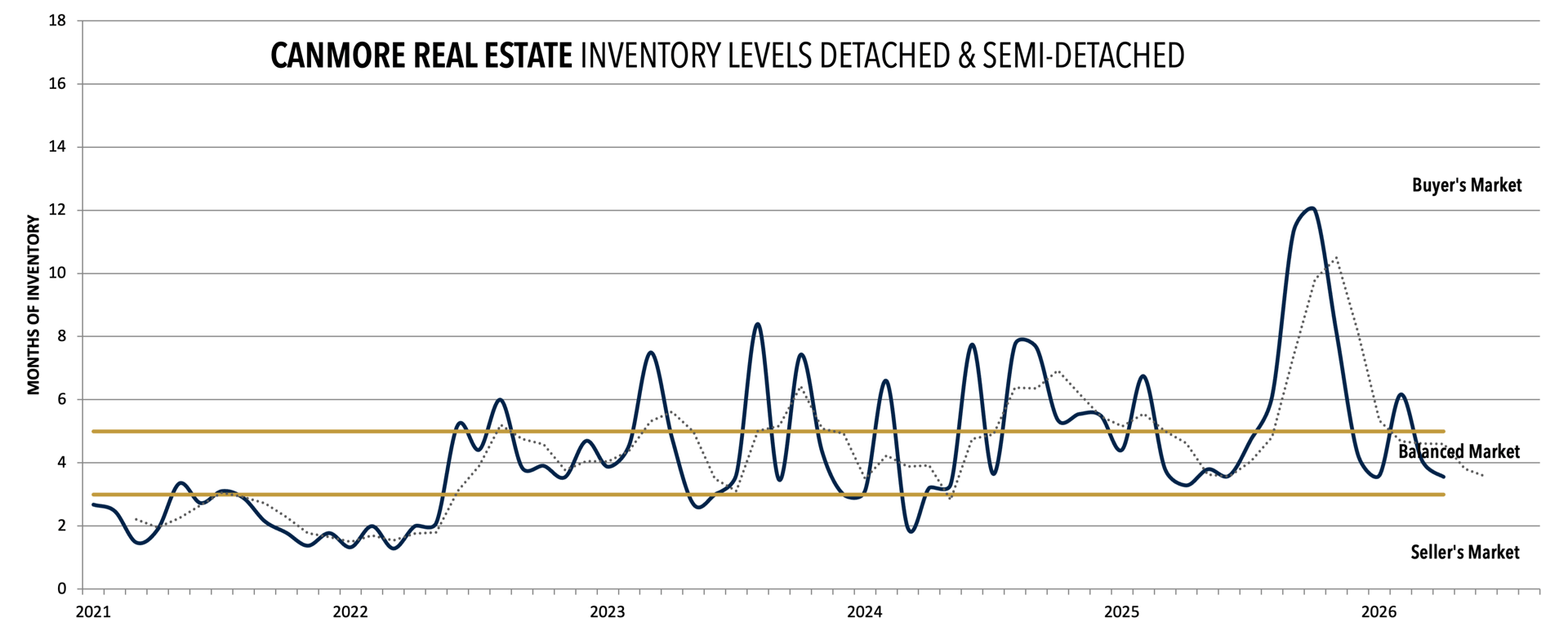
Active listings have increased steadily since late 2025, and the market is now operating from a higher baseline of available supply heading into the spring season. This contrasts sharply with the ultra-low inventory environment seen from 2021 through early 2023, when even modest listing increases were quickly absorbed.
Today, the dynamics are different:
- Buyers have more selection and time to evaluate opportunities
- Sellers are facing greater competition and pricing sensitivity
- The market is less reactive, more deliberate
Historically, inventory expands into the spring months. In 2026, however, that expansion is beginning earlier and from a more elevated level—suggesting a more competitive listing environment in the months ahead.
Sales Activity: Stable, With Pockets of Volatility
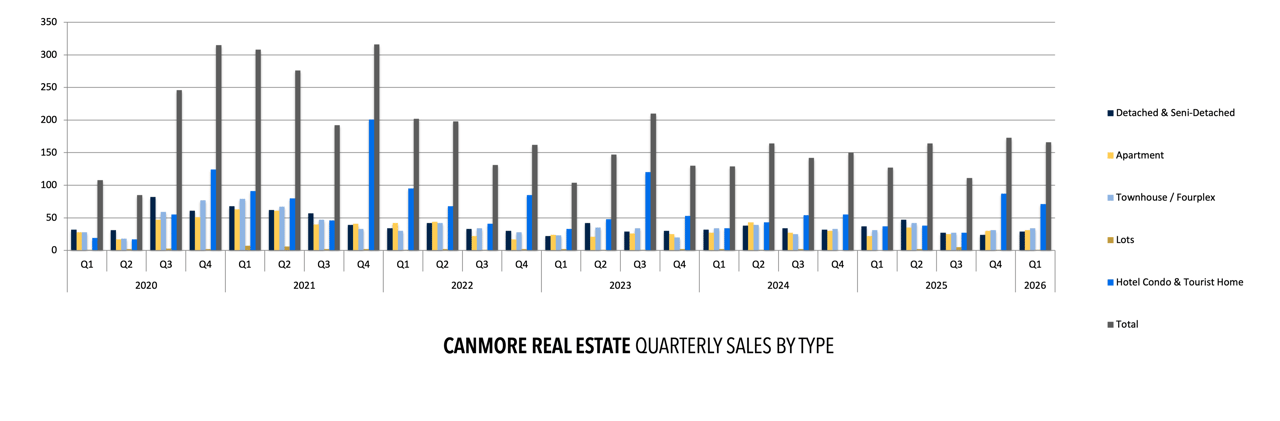
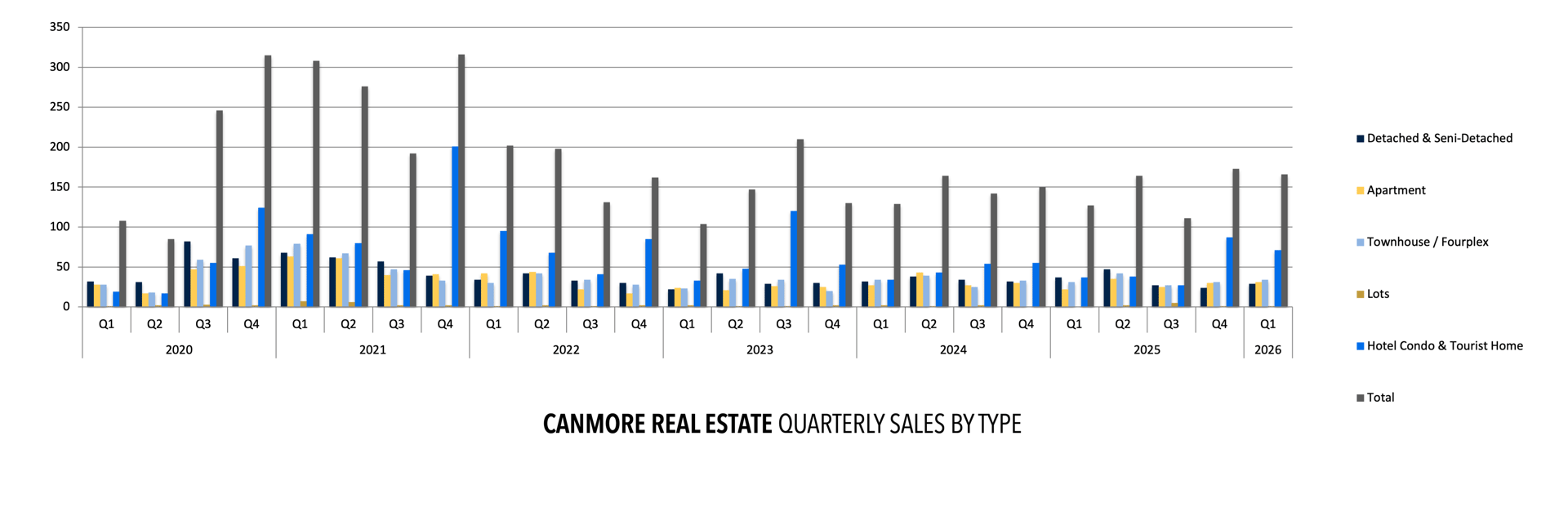
Sales volumes in Q1 show a measured recovery from late 2025, though still below peak seasonal quarters typically seen in Q2 and Q3.
Monthly activity reveals an uneven pattern:
- February stands out with elevated transaction volume
- January and March reflect more normalized activity levels
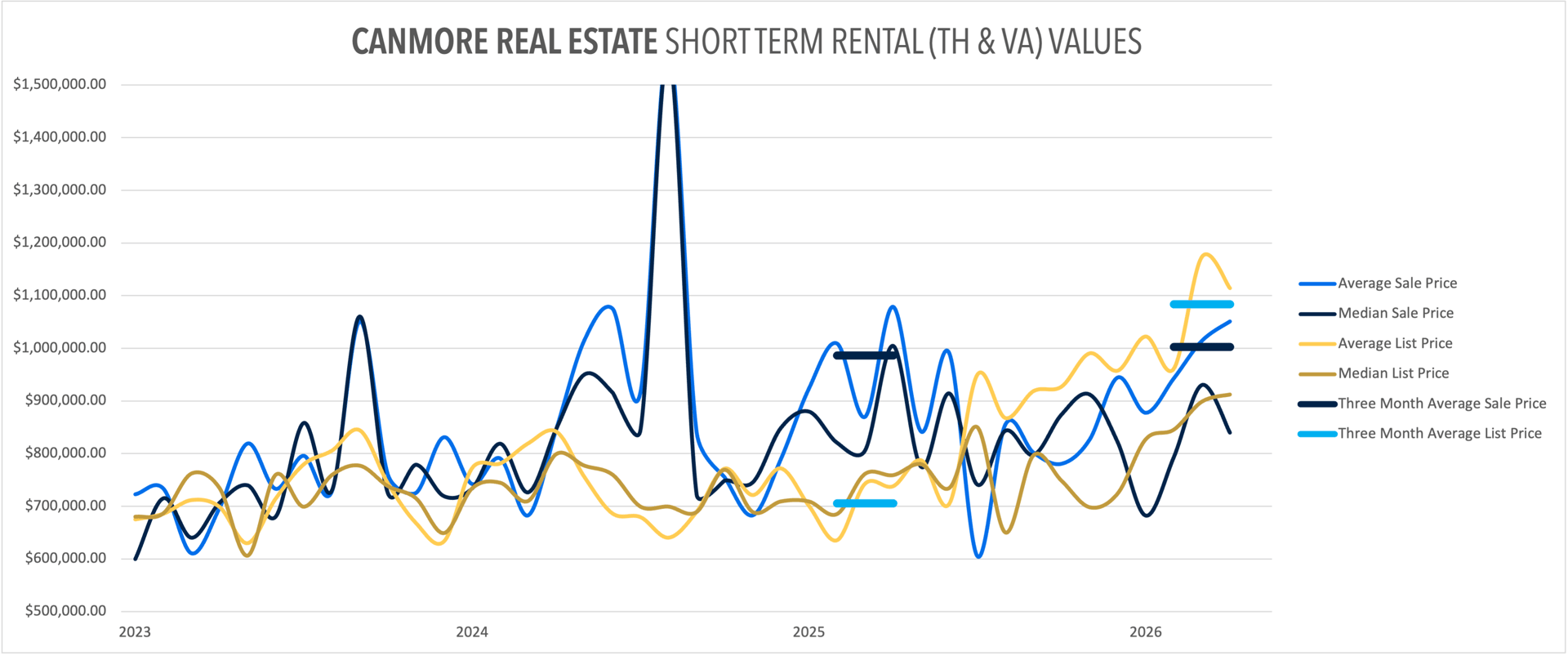
This unevenness is particularly evident in the short-term rental segment, where sales spikes are tied to new development releases rather than organic resale demand.
Short-Term Rentals: Strong Demand, Distorted Data
The short-term rental (STR) segment continues to be one of the most closely watched—and often misunderstood—areas of the Canmore market.
Large spikes in sales volume are not indicative of sudden surges in demand, but rather the result of new project launches, where units are often sold in rapid succession.
This has several implications:
- Demand remains strong, particularly for well-located investment properties
- The resale market is still relatively constrained, with limited available inventory
- Reported inventory increases are often temporary, reflecting project releases rather than sustained oversupply
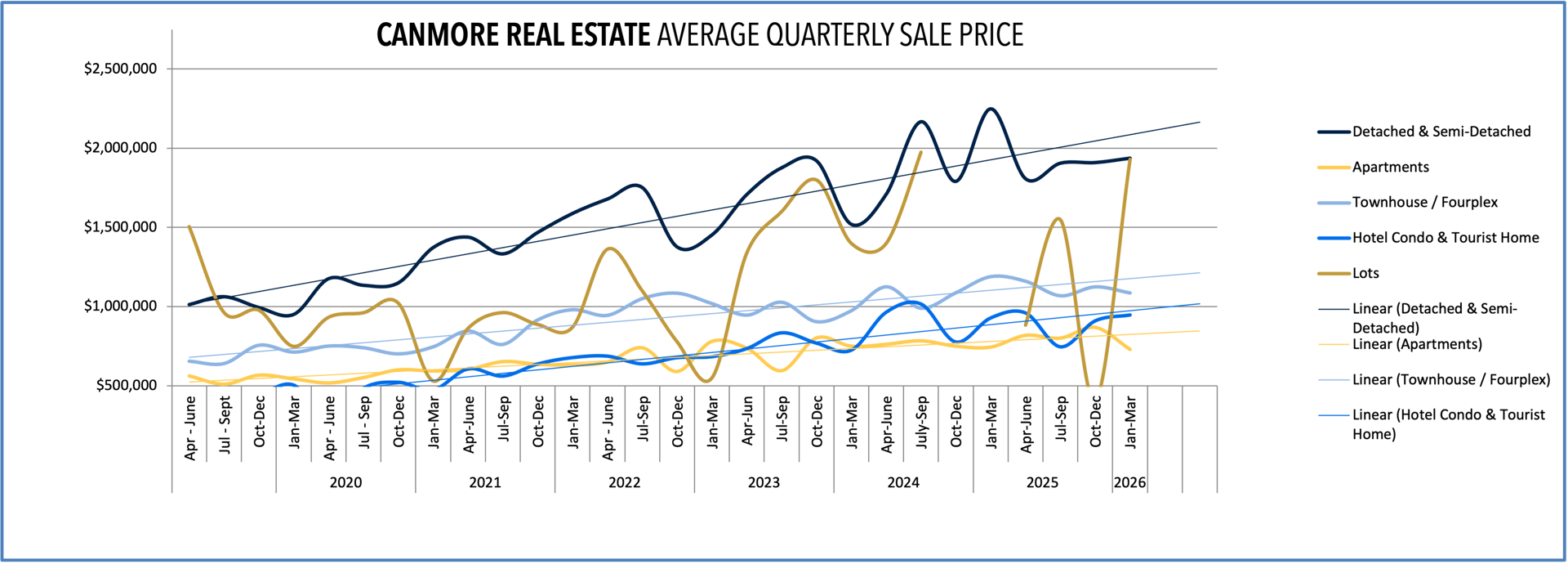
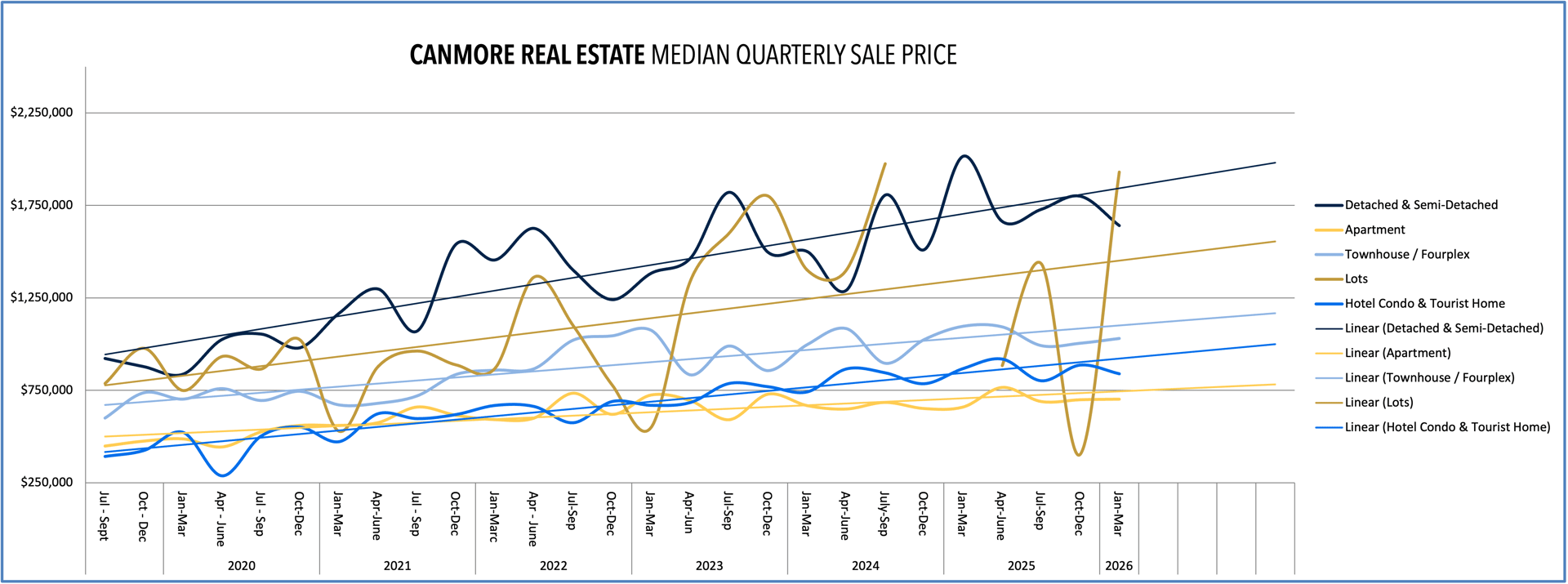
Pricing trends reinforce this strength. While monthly averages can fluctuate based on product mix, three-month averages continue to trend upward, with many STR properties approaching or exceeding the $1 million mark.
The result is a segment that is transitioning toward balance, but remains fundamentally supported by investor demand and the Bow Valley’s year-round tourism appeal.
Residential Market: Diverging Conditions by Property Type
The broader residential market—detached homes, townhomes, and apartments—is no longer moving in unison. Each segment is responding differently to rising inventory.
Detached & Semi-Detached Homes: From Buyer to Balanced
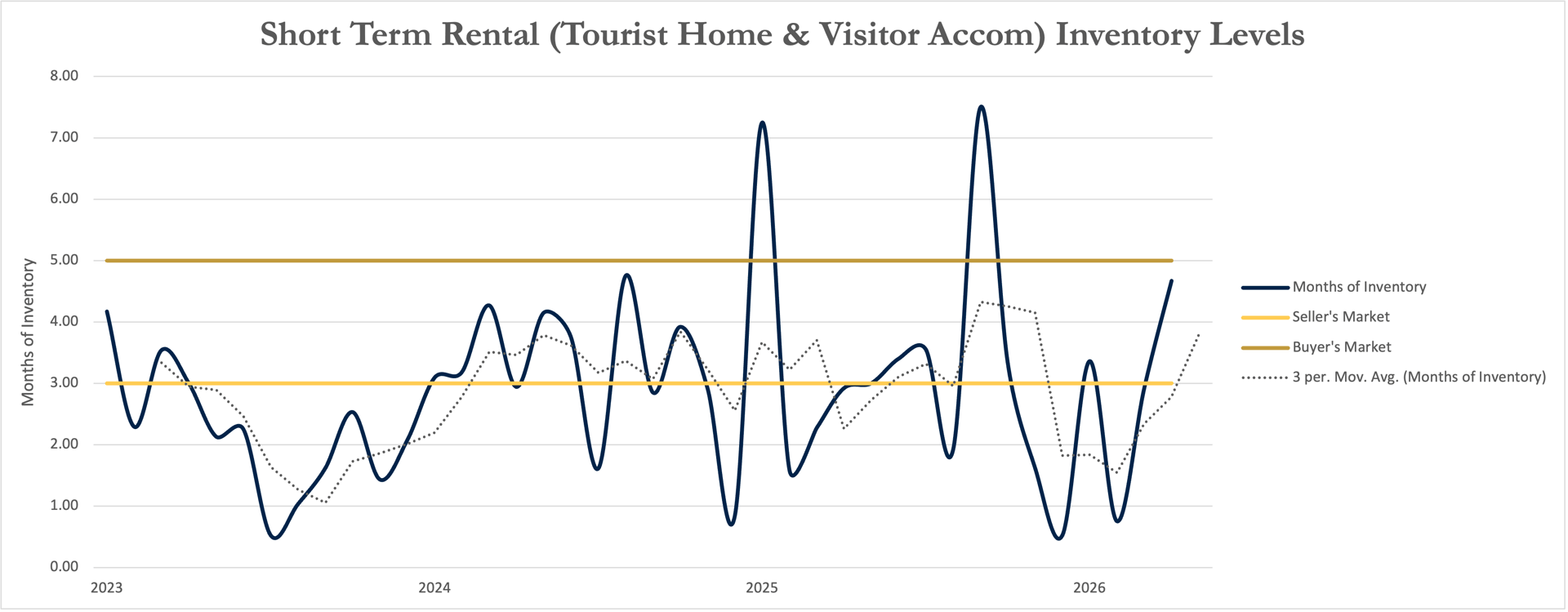
Detached homes experienced the most pronounced shift in 2025, with inventory levels briefly pushing into clear buyer’s market territory.
In Q1 2026:
- Inventory has moderated into the balanced range (approximately 3–5 months)
- Sales remain inconsistent, reflecting sensitivity at higher price points
- Pricing is stable but no longer accelerating, with some variability month-to-month
This segment now represents a negotiated market, where pricing strategy and product quality are critical.
Townhomes: The Market’s Anchor
Townhomes continue to offer the most stability:
- Inventory remains tightly managed within balanced conditions
- Demand is consistent across quarters
- Prices are firm and trending upward on a three-month basis
This segment benefits from its positioning:
- More attainable than detached homes
- More functional than apartments for many buyers
As a result, it remains a core segment for both primary and secondary buyers, with limited volatility.
Apartment Condos: Emerging Buyer Opportunity
The apartment segment is where the impact of rising inventory is most visible.
Q1 data shows:
- Periods of elevated inventory, at times exceeding traditional buyer’s market thresholds
- Greater variability in sales activity
- Softer average pricing, driven largely by new entry-level product entering the market
For buyers, this translates into:
- More choice
- Increased negotiating power
- Opportunities in both entry-level and investment-oriented properties
For sellers, it introduces a more competitive environment where pricing and presentation are essential.
Pricing: Resilient, But More Sensitive
Despite rising inventory, pricing across the Canmore market remains remarkably resilient.
Long-term trends continue to show:
- Sustained upward movement in all major property types
- Particularly strong performance in detached homes and townhomes
However, the market is now more sensitive to:
- Property type and location
- Quality and condition
- Pricing relative to competing listings
In short, pricing is holding—but no longer guaranteed to outperform without strategy.
Days on Market: A Return to Normalcy
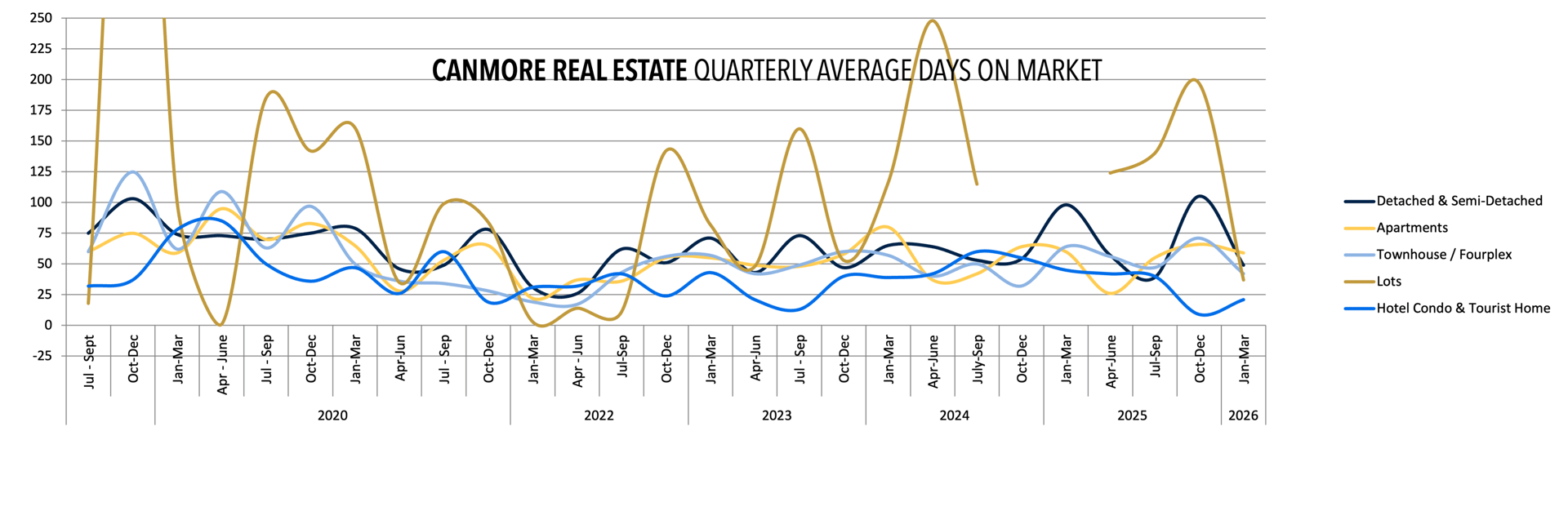
Days on market in Q1 2026 are stable, with slight increases relative to peak seller conditions.
This is a meaningful shift:
- Buyers are taking more time
- Conditional offers are more common
- The pace of decision-making has normalized
Importantly, this is not indicative of a slow market—rather, a functioning one.
The Bottom Line: A More Sophisticated Market Emerges
Q1 2026 marks a transition point for the Canmore real estate market.
- Inventory is rising, but not excessive
- Demand remains intact, though more selective
- Pricing is stable, but increasingly dependent on positioning
The result is a market that is less defined by urgency and more by strategy.
For buyers, this is an environment of opportunity—particularly in apartments and select investment properties.
For sellers, it is a market that rewards preparation, pricing discipline, and high-quality marketing.
And for the broader Bow Valley, it reinforces a familiar truth: while short-term conditions evolve, the long-term fundamentals—limited land supply, global demand, and lifestyle appeal—remain firmly in place.